
Building Major Scales: A 14 Major Scales Challenge for Music Students

What if learning major scales became a challenge your students actually wanted to complete?
Learning to construct major scales is an important part of music theory, but completing scale after scale on a worksheet isn't always exciting for students.
What if we could make that practice more engaging?
A teacher who purchased my Building Major Scales worksheets shared this wonderful classroom idea:
"I was able to have a 'scale challenge' where they had to figure out all 12 major scales and then play them. Great way to get students to invest in their own learning!"
I loved this idea because it takes music theory beyond the worksheet. Students aren't simply identifying notes and accidentals — they're applying their knowledge, developing practical skills and taking responsibility for their own progress.
Inspired by this teacher's experience, here's how you can organise a 14 Major Scales Challenge for your middle school or high school music students.
Before You Begin: Teach Students How to Build Major Scales
The 14 Major Scales Challenge is a follow-up activity for students who have already learned to construct major scales.
Before beginning, students should understand the major scale pattern:
Whole Step – Whole Step – Half Step – Whole Step – Whole Step – Whole Step – Half Step
Or, using British terminology:
Tone – Tone – Semitone – Tone – Tone – Tone – Semitone
They should also know how to apply this pattern to different starting notes and use sharps and flats to create the correct intervals.
Once students have completed guided practice and can construct scales with growing confidence, they're ready for the challenge.
Why Use Accidentals Instead of Key Signatures?
In this activity, students write major scales using individual accidentals placed in front of the notes, instead of key signatures.
By applying the whole-step, half-step (tone and semitone) pattern, students work out which notes need to be raised or lowered.
This helps them understand why sharps and flats are needed, rather than relying on memorised key signatures.
Key signatures and the Circle of Fifths can be introduced later, once students have a solid understanding of scale construction.
The 14 Major Scales Challenge: Build It • Write It • Play It!
Many major scale challenges focus on playing the scales.
Our challenge goes a step further.
Because students must construct, write and play each scale, they also explore enharmonic equivalents. For example, C♯ major and D♭ major sound the same on a piano tuned in equal temperament, but they're written differently. The same is true of F♯ major and G♭ major.
By including these enharmonic equivalents, students practise accurate note spelling and learn why note names matter, even when scales sound identical.
This challenge includes 14 commonly taught written major scales, excluding C♭ major.
How it Works
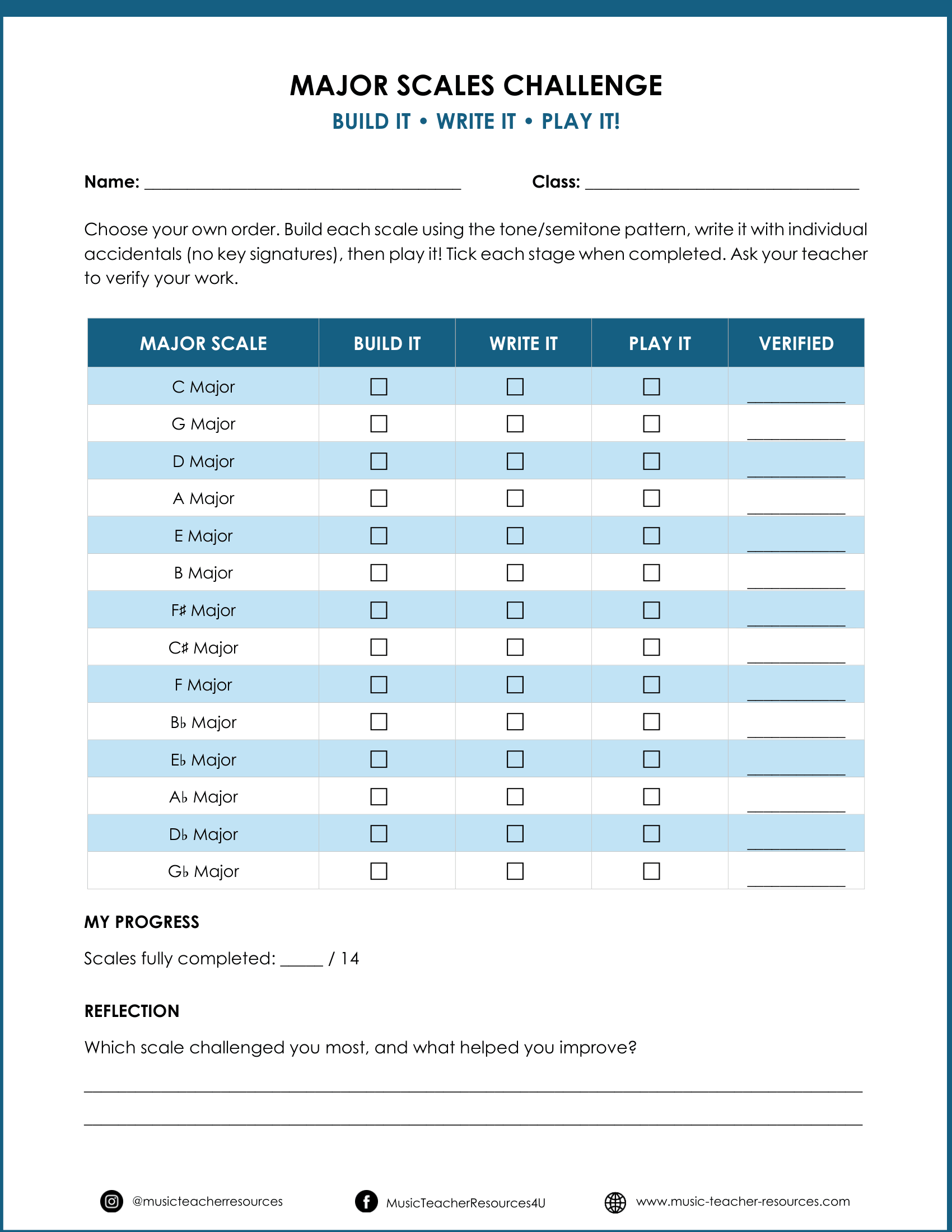
The challenge is simple: students work independently to construct, notate, and perform 14 major scales.
There are three stages:
BUILD IT: Work out the correct notes of each major scale using the whole-step and half-step (tone and semitone) pattern, identifying where accidentals are needed.
WRITE IT: Notate each scale accurately on the staff, placing individual sharps or flats in front of the appropriate notes.
PLAY IT: Perform each scale on an instrument to connect written music theory with practical music-making.
Students choose the order in which they complete the scales and work at a pace appropriate to their ability.
Step 1: Introduce the Challenge
Explain that the goal is to complete all 14 major scales, demonstrating understanding through written work and performance.
Provide students with their major scale worksheets or manuscript paper and a challenge tracker to record their progress.
There is no prescribed order. Students can begin with a scale they feel confident constructing and gradually tackle more challenging ones.
Step 2: Build and Write the Scales
Students apply the major scale pattern to determine the correct notes and accidentals, then notate each scale on the staff.
Encourage them to check that:
- The correct whole-step, half-step (tone and semitone) pattern has been followed.
- Each letter name appears once only before returning to the tonic.
- Accidentals are written in front of the appropriate notes, not as a key signature.
- Notes are positioned correctly on the staff.
Step 3: Play the Scales
Once students have correctly constructed and written a scale, they practise performing it on an instrument.
Depending on your classroom, students might use keyboards, guitars or band and orchestral instruments.
Keep performance expectations achievable. Playing a scale slowly and accurately is more important than playing it quickly.
For students using transposing instruments, decide whether the task will use instrument-specific written scales or concert-pitch scales, and adapt the notation and performance requirements accordingly.
Step 4: Track Progress and Celebrate Achievement
Give students a Major Scales Challenge Tracker to record each completed stage.
Students can tick off BUILD IT, WRITE IT and PLAY IT as they work through the scales.
The tracker helps students see their progress, identify what still needs practice and take responsibility for their learning.
Rather than turning the activity into a race, encourage students to focus on accuracy, improvement and completing the challenge to the best of their ability.
FREE PRINTABLE: Major Scales Challenge Tracker
DOWNLOAD YOUR FREE MAJOR SCALES CHALLENGE TRACKER
Adapting the Challenge for Your Students
The challenge can be adapted for different ages, abilities and teaching situations.
Beginners might start with a few familiar scales before gradually working toward all the major scales.
More confident students can work independently, perform scales from memory, or explain how they're constructed.
General music students could demonstrate their scales on classroom keyboards or another available instrument.
The challenge can run over several lessons or become an ongoing project. Students may practise at home, but make sure those without access to an instrument have opportunities to complete the performance stage during class.
Building Major Scales Worksheets to Support the Challenge
Looking for ready-to-use materials to teach major scale construction before introducing the challenge?
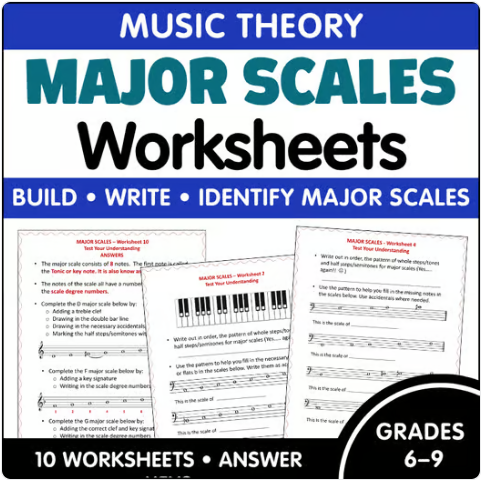
My Building Major Scales – Music Theory Worksheets provide structured practice in constructing and notating major scales using individual accidentals.
Designed for middle school and high school students, they're ideal for introducing the concept, guided practice, revision and building the confidence students need to work independently.
Explore the Building Major Scales Worksheets on TpT
From Music Theory to Music-Making
The Major Scales Challenge gives students an opportunity to put their music theory knowledge into practice.
By constructing, writing, and performing major scales, students reinforce their understanding of whole and half steps (tones and semitones) and accidentals while building confidence and independence.
And once students understand how major scales are built, they're better prepared to explore key signatures and the Circle of Fifths.
Sometimes, a simple classroom challenge can make all the difference!
Would you like more music teaching strategies? Check out these related posts to keep your lessons fresh and interactive!
Blog Post: Top Tips for Planning a Student Concert
Blog Post: Halloween Music Bingo: A Fun and Easy October Music Lesson
Blog Post: 8 Ways to Use Google Slides in the Music Classroom
Blog Post: 10 Fun and Effective Music Class Seating Plan Ideas

Sign up to receive the monthly MTR newsletter and gain exclusive access to the
FREE Resource Library for music teachers!
